How Often Should You Book Commercial Window Cleaning in Sydney? [2026 Guide]

Table of Contents
How Often Should You Book Commercial Window Cleaning in Sydney?
Most commercial buildings in Sydney should have their windows professionally cleaned every 3 to 6 months. CBD office towers and harbour-facing properties typically require quarterly cleaning (every 3 months) due to heavy exposure to salt spray, traffic pollution, and construction dust. Suburban commercial buildings and office parks generally maintain professional presentation with bi-annual cleaning (every 6 months).
The right commercial window cleaning frequency for your building depends on location, exposure to environmental contaminants, building height, tenant expectations, and your maintenance budget. Buildings with protective glass coatings or those located in low-pollution areas may extend to annual cleaning, while high-visibility retail shopfronts often require weekly or fortnightly service.
I've been managing commercial window cleaning projects across Sydney since 2010, and the most common question I hear from building managers isn't "how much does it cost?" — it's "how often do we actually need to do this?"
It's a fair question. You're juggling maintenance budgets, tenant expectations, strata committee demands, and about 47 other priorities that all seem more urgent than clean windows. Until someone emails a photo of streaky, salt-crusted glass on Level 14, and suddenly window cleaning jumps to priority one.
Here's the thing: there's no universal answer. A commercial window cleaning Sydney schedule that works perfectly for a boutique office in Chatswood won't cut it for a 30-storey tower at Circular Quay. But there are clear guidelines based on building type, location, and exposure — and that's exactly what I'll break down for you here.
Commercial Window Cleaning Frequency Guide by Building Type
Let me give you the practical framework I use when building managers ask me to recommend a cleaning schedule. This isn't theory — it's based on 15+ years of working with over 500 Sydney commercial properties, from 3-storey suburban offices to 50-storey CBD landmarks.
CBD Office Towers
Every 3 months (Quarterly)
High-traffic CBD locations face the perfect storm: vehicle emissions, harbour salt spray, and constant construction dust. Glass deterioration is measurable after 90 days in these environments.
Harbour-Facing Buildings
Every 3 months (Quarterly)
Any property within 5km of Sydney Harbour or coastal areas battles salt accumulation year-round. Skip quarterly cleaning and you're risking permanent glass etching by month six.
Retail Shopfronts
Weekly to Fortnightly
Ground-level retail and café windows are your first sales tool. Customer perception shifts dramatically with clean glass, making weekly or fortnightly service standard for high-street retail.
Suburban Office Buildings
Every 6 months (Bi-annual)
Commercial buildings in Parramatta, Macquarie Park, Chatswood, and other suburban business districts face lower pollution levels. Bi-annual cleaning maintains professional presentation cost-effectively.
Mixed-Use Developments
Every 6 months (Bi-annual)
Residential-commercial mixed-use buildings balance tenant expectations with cost distribution across strata levies. Bi-annual schedules are the most common in these properties.
Industrial & Warehouse
Every 12 months (Annual)
Office glazing in industrial estates and warehouse facilities sees less public exposure and lower pollution. Annual cleaning with defect reporting is typically sufficient.
Why Location Matters More Than You Think
I worked on two nearly identical 12-storey office buildings last year — same architect, same glazing system, built within three years of each other. One's in North Sydney near the harbour. The other's in Castle Hill.
The North Sydney building requires quarterly cleaning. The Castle Hill property looks great with bi-annual service. Same building profile, totally different commercial window cleaning schedule.

That's because Sydney's environmental conditions vary dramatically across just a few kilometres. Here's what actually affects your glass between cleanings:
Salt Spray & Coastal Exposure
If your building is within 5km of Sydney Harbour, the coast, or any significant body of saltwater, you're dealing with salt accumulation whether you see it or not. Salt doesn't just sit on the surface — it chemically bonds with glass over time, creating a haze that eventually becomes permanent etching.
I've seen building managers wait 12 months between cleanings on harbour-facing towers.
By the time they called us, the salt deposits had etched so deeply into the glass that cleaning couldn't fully remove them. That's not a $3,000 cleaning invoice anymore — that's individual glass panel replacement at $800–$2,000 per panel.
Coastal Reality Check: Buildings in Bondi, Manly, Circular Quay, Barangaroo, and the Eastern Suburbs need quarterly cleaning minimum. This isn't optional if you want to avoid permanent glass damage.
Traffic Pollution & Urban Density
The Sydney CBD and major arterial roads produce a constant stream of exhaust particulates that settle on building facades. This creates a thin film of carbon-based grime that's nearly invisible at first — until sunlight hits it at the right angle and your windows look like they haven't been cleaned in years.
Buildings near Parramatta Road, the M4 corridor, Victoria Road, and Anzac Parade cop this harder than anyone else. Add construction dust from Sydney's non-stop development boom, and you've got glass that degrades in presentation every single week.
Construction Dust & Development Zones
If there's active construction within 500 metres of your building, double your expected window cleaning frequency. Construction dust isn't just annoying — it's abrasive. When it sits on glass and gets wet from rain, it forms a cement-like layer that traditional cleaning methods struggle with.
I worked with a property manager in Green Square who tried to stretch their cleaning schedule from 6 months to 12 months while three apartment towers were being built around them. By month nine, the glazing contractors told them half their external panels would need restoration — not cleaning.
CBD & Office Tower Window Cleaning Schedule
Let's talk about the buildings everyone sees — the ones that define Sydney's skyline. If you manage or own a high-rise window cleaning Sydney property in the CBD, North Sydney, or Barangaroo, your glazing is under constant assault from environmental factors you can't control.
These aren't residential windows that you clean when they look dirty. These are high-value commercial assets where perception, tenant satisfaction, and property value are directly tied to presentation. You don't want to be the building manager explaining to a prospective tenant why the views they're paying premium rent for are obscured by grime.
The Quarterly Standard for CBD Properties
Every major office tower in Sydney operates on a quarterly window cleaning contract — meaning professional service every three months without exception. Why? Because that's the longest interval that maintains professional presentation in Sydney's CBD environment.
I've supervised quarterly contracts for buildings including Salesforce Tower, AMP Quay Quarter, and dozens of North Sydney corporate addresses. The pattern is consistent: by month three, salt haze and pollution build-up are clearly visible. By month four, you're fielding tenant complaints.
What Quarterly Cleaning Achieves:
Prevents permanent salt etching and glass degradation
Maintains premium presentation for high-value tenancies
Meets tenant expectations for Grade A office space
Protects long-term glass integrity and extends lifespan
Provides regular facade inspections for maintenance issues
Supports Green Star and NABERS building certifications
After-Hours & Weekend Scheduling
One of the biggest concerns I hear from CBD building managers is disruption. You can't have rope access technicians working outside office windows during business hours — it's distracting for tenants and creates WHS concerns.
That's why every CBD office tower cleaning we do happens outside core business hours. Early mornings (5am–9am), evenings (5pm–10pm), or weekends. Your tenants arrive Monday morning to spotless windows and never knew we were there.
Retail Shopfront & Ground-Level Window Cleaning
If you manage retail space — whether it's a standalone shopfront, a shopping centre tenancy, or a ground-floor hospitality venue — your window cleaning frequency operates on a completely different timeline.
For retail, the window isn't just glazing. It's your first marketing touchpoint. Research consistently shows that clean, clear glass increases foot traffic and dwell time. Streaky, dusty windows signal neglect, and potential customers unconsciously associate that with lower quality products or service.
Weekly & Fortnightly Service for High-Traffic Retail
Most successful retail operators in Sydney's high-streets — Pitt Street Mall, George Street, King Street Newtown, Oxford Street Paddington — clean their shopfront glass weekly or fortnightly at minimum. Some flagship stores and luxury retail clean daily.
Why? Because ground-level glass collects fingerprints, dust, and street grime at a rate that's impossible for upper-level commercial windows. Add weather, passing traffic, and the occasional coffee spill from a pedestrian, and you're starting every week with diminished presentation.
Retail Pro Tip: Schedule shopfront cleaning before your busiest trading days. If weekend foot traffic drives your revenue, book Friday morning cleaning. If you're a Monday-to-Friday lunch spot, Monday morning service ensures you start the week sharp.
Suburban Commercial & Office Park Window Cleaning
Not every commercial building needs quarterly service. If your property is located in Parramatta, Macquarie Park, Chatswood, North Ryde, Norwest Business Park, or other suburban commercial districts, you're working with a different environmental profile.
Lower traffic density, reduced pollution exposure, and increased distance from saltwater means your glazing degrades more slowly. That doesn't mean you can skip professional cleaning — it just means you can maintain excellent presentation with less frequent service.
Bi-Annual Cleaning for Suburban Properties
The most common commercial window cleaning frequency for suburban Sydney office buildings is bi-annual — meaning professional cleaning twice per year, typically scheduled for spring (September/October) and autumn (March/April).
This schedule works because:
Pollution accumulation is slower than CBD environments
Salt spray exposure is minimal or non-existent
Buildings are often surrounded by landscaping that filters dust
Tenant expectations align with cost-effective maintenance
I work with property managers across Western Sydney and the Lower North Shore who've maintained bi-annual contracts for years without any presentation issues. The key is consistency — don't skip a scheduled clean because the weather looks okay or the budget's tight that quarter. Once you fall behind, it costs more to catch up than it does to maintain the schedule.

High-Rise & Multi-Storey Building Cleaning Logistics
If you're managing a building above five storeys, your window cleaning schedule isn't just about frequency — it's about access method, logistics, and cost efficiency. And that's where rope access window cleaning becomes the only practical solution for regular maintenance.
Traditional methods like mobile elevated work platforms (MEWPs), swing stages, or building maintenance units (BMUs) come with logistical nightmares: council permits, footpath closures, loading dock barricades, and multi-day setup times. For a building that needs quarterly cleaning, that's 8–12 days per year where your loading dock is unusable and your building entrance looks like a construction site.
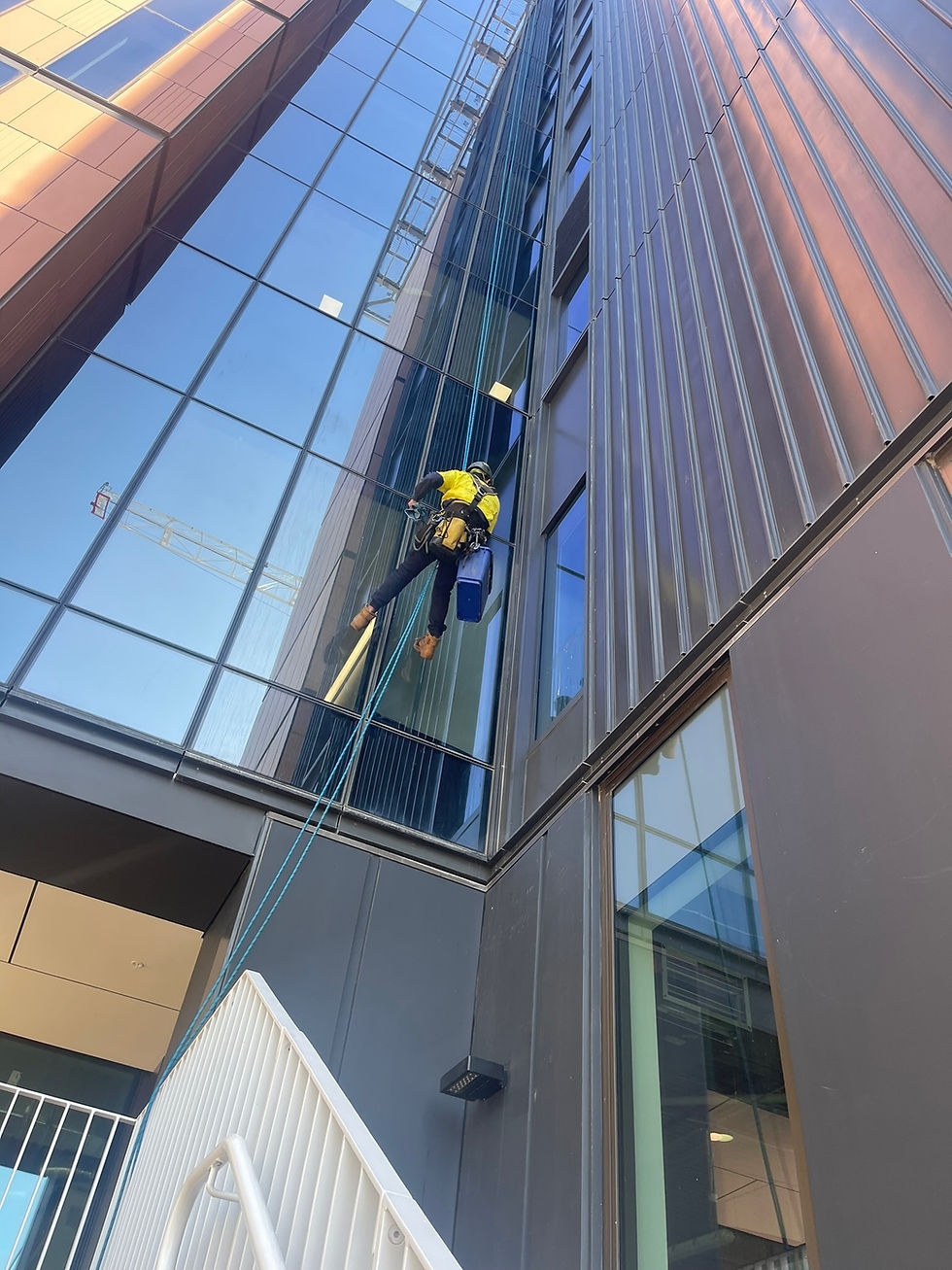
Rope access eliminates all of that. Our IRATA-certified teams anchor from the roof, descend floor-by-floor, and complete the job in a fraction of the time — with zero street-level disruption and no permits required. For buildings on regular maintenance contracts, that means faster scheduling, lower cost per clean, and no operational headaches for building management.
What Factors Should Change Your Cleaning Schedule?
The frequencies I've outlined above are industry-standard starting points. But your specific building might need adjustments based on factors that aren't immediately obvious. Here's what actually changes the equation:
Factor | Impact on Frequency | Recommendation |
Reflective or Dark Glass | Shows streaks and water spots more visibly | Increase frequency by 1 level (e.g., bi-annual → quarterly) |
Ground-Floor Retail | High visibility to foot traffic; fingerprints and dust accumulate daily | Weekly or fortnightly minimum |
Nearby Construction | Dust and cement particulates accelerate grime build-up | Double usual frequency while construction is active |
Glass Protective Coatings | Hydrophobic coatings repel water and contaminants | Can extend interval by 3–6 months |
Heavy Tree Coverage | Pollen, sap, and bird droppings increase | Maintain or increase frequency; sap damage is permanent if left |
Harbour or Beach Proximity | Salt spray causes rapid glass degradation | Quarterly minimum; monthly for properties under 1km from water |
Tenant Expectations & Lease Obligations
Here's something most building managers learn the hard way: tenant expectations often dictate cleaning frequency more than environmental factors do.
If you're managing a building with high-value tenancies — law firms, financial services, tech companies paying premium rent — they expect premium presentation. That means quarterly cleaning regardless of actual environmental necessity. It's written into their perception of the building's service standard.
I've also seen commercial leases that explicitly require "professional window cleaning no less than quarterly" as a building maintenance obligation. If that's in your lease agreements, you're not negotiating frequency — you're legally committed to it.
The Real Cost of Skipping Scheduled Window Cleaning
Let's talk about what happens when building managers try to "save money" by stretching cleaning intervals or skipping scheduled maintenance. Because I've seen this play out dozens of times, and it never ends with actual savings.
Permanent Glass Damage & Replacement Costs
The single most expensive consequence of deferred window cleaning is irreversible glass damage. When salt, mineral deposits, and pollution sit on glass for extended periods — especially through Sydney's wet winter months — they don't just sit on the surface. They chemically bond with the glass itself.
What building managers see as "just dirty windows" is often early-stage glass etching that professional cleaning can still reverse. But wait another 6–12 months, and you're past the point of no return. The glass is permanently hazed, and the only fix is panel replacement.
Glass replacement costs in Sydney commercial buildings range from $800 to $2,000+ per panel depending on size, height, and glazing specifications. For a mid-rise office building with 200 external panels, replacing even 10% of your glass due to deferred cleaning means $16,000–$40,000 in avoidable costs.
Compare that to a bi-annual maintenance contract that costs $3,000–$6,000 per year. The math isn't close.
Tenant Complaints & Lease Implications
Commercial tenants paying premium rent expect premium presentation. When windows remain dirty for months, tenant dissatisfaction escalates through predictable stages:
Tenant Complaint Timeline:
Month 1–3: Informal comments to building management
Month 4–6: Formal complaints via email with photos
Month 7–9: Lease breach notifications citing maintenance obligations
Month 10+: Rent reduction demands or early lease termination discussions
I've worked with building managers who faced exactly this scenario. One property in North Sydney delayed quarterly cleaning for 18 months to "control costs." By month 14, their largest tenant — a financial services firm occupying three floors — formally requested a 5% rent reduction citing failure to maintain building presentation standards outlined in their lease.
The rent reduction cost more in one year than five years of quarterly window cleaning would have.
Property Value & Investment Returns
If you're managing a commercial property on behalf of investors or a strata committee, understand that deferred maintenance directly impacts asset value. Commercial property valuations factor in presentation, tenant satisfaction, and maintenance track records.
A building with documented, consistent window cleaning maintenance is worth more — and sells faster — than an equivalent property with inconsistent maintenance history and visible glass degradation.
Should You Book a Commercial Window Cleaning Maintenance Contract?
Here's the most effective advice I can give any building manager asking about commercial window cleaning frequency: don't book individual cleans. Book a maintenance contract.
A properly structured maintenance contract solves every scheduling problem we've talked about in this article. You're not chasing quotes when windows look dirty. You're not trying to coordinate availability during your busiest quarter. You're not explaining to the strata committee why cleaning wasn't completed on time.
Instead, your building is on a fixed schedule, your facilities records are current, and your budget is predictable. When I work with building managers who transition from ad-hoc booking to maintenance contracts, they consistently report less stress, better presentation, and lower overall costs.
How Maintenance Contracts Actually Work
A commercial window cleaning maintenance contract with Select Abseiling Solutions includes:
Fixed Schedule: Agreed cleaning frequency (quarterly, bi-annual, or annual) locked in for 12 months with calendar confirmations sent 2 weeks before each service
Priority Booking: Your site is never bumped for one-off jobs; weather delays are rescheduled within 5 business days
Written Reports: Completion report with photos emailed within 24 hours of every clean, plus defect notifications for any glass damage, seal failure, or frame issues identified
Insurance on File: Certificate of currency permanently on file for strata managers, building owners, and insurance audits
Single Invoice: One monthly or quarterly invoice for accounts, not separate invoicing for each visit
Discount Pricing: 15–25% lower than one-off rates, locked in for the contract term
Quarterly vs Bi-Annual vs Annual Contracts
Most Sydney commercial buildings fit into one of three contract structures:
Quarterly Contracts are standard for CBD towers, harbour-facing buildings, and high-traffic retail. You're committing to four cleans per year, scheduled approximately 90 days apart. This is the highest-frequency option and typically reserved for properties where presentation is critical and environmental exposure is high.
The cost of commercial window cleaning on a quarterly contract is usually 20–25% lower than one-off pricing, and you're guaranteeing your building never falls behind on presentation.
Bi-Annual Contracts are the most popular choice for suburban commercial buildings, mixed-use developments, and mid-rise office parks. Two cleans per year — typically spring and autumn — maintain professional presentation without the cost commitment of quarterly service.
This is the sweet spot for most Sydney commercial properties. You're saving 15–20% compared to ad-hoc booking, and you're maintaining the schedule that prevents glass degradation.
Annual Contracts work for industrial properties, low-traffic office buildings, and properties with protective glass coatings that slow contamination. One comprehensive clean per year, typically scheduled before major inspections or end-of-financial-year reporting.
Even annual contracts include full facade inspection and written maintenance reports, so you're documenting building condition for asset management purposes.
Best Practices for Commercial Window Cleaning Scheduling
After 15 years managing commercial window cleaning projects across Sydney, here's what I've learned actually works when it comes to scheduling and maintenance planning:
Schedule Before You Need It
The least effective time to book commercial window cleaning is when your windows look dirty. By that point, you're reactive — and reactive maintenance is always more expensive and more disruptive than planned maintenance.
The most successful building managers I work with schedule their entire year of window cleaning in January. They know exactly when service is happening, they've budgeted for it, and they never have to scramble for availability during peak booking periods (spring and pre-Christmas).
Communicate the Schedule to Tenants
One simple step that dramatically reduces tenant complaints: send a one-paragraph email notification 48 hours before scheduled cleaning.
Tell tenants that professional window cleaning is scheduled, that technicians may be visible working outside their windows, and that the building's presentation and glass longevity are being actively maintained. It takes 5 minutes to send, and it completely eliminates surprise or concern from tenants who aren't expecting to see rope access technicians outside their office.
Document Everything
Every window cleaning service should generate a written completion report with photos. If your current provider doesn't do this automatically, request it — or find a provider who includes it as standard.
These reports serve three purposes:
Proof of Maintenance: Demonstrates to strata committees, building owners, or insurance auditors that scheduled maintenance obligations are being met
Defect Tracking: Documents glass damage, seal failures, or frame deterioration before they become expensive problems
Legal Protection: Protects building managers from tenant claims that maintenance wasn't performed if disputes arise
I've had building managers tell me these reports were critical evidence during lease disputes and insurance claims. It's not just paperwork — it's legal protection.
Plan Around Sydney Weather
Sydney's weather is unpredictable, and window cleaning can't happen safely in heavy rain or strong winds. That means weather delays are inevitable — but they don't have to derail your maintenance schedule if you plan intelligently.
The best booking windows for commercial window cleaning in Sydney are:
March to May (Autumn): Stable weather, lower wind, reduced rainfall
September to November (Spring): Clear conditions and perfect timing before summer salt accumulation
Avoid scheduling primary cleans during June–August (Sydney's wettest months) unless you have flexible rescheduling options. Winter cleaning often requires 2–3 weather postponements before conditions allow safe rope access work.
Need a Custom Maintenance Plan for Your Building?
Select Abseiling Solutions provides free on-site assessments and fixed-price maintenance contracts for commercial buildings across Sydney. We'll evaluate your building's specific exposure, recommend the optimal cleaning frequency, and provide transparent pricing with no hidden fees.
Frequently Asked Questions
How often should office windows be cleaned in Sydney?
Office windows in Sydney CBD and harbour-facing locations should be cleaned every 3 months (quarterly). Suburban office buildings in areas like Parramatta, Macquarie Park, and Chatswood typically maintain professional presentation with bi-annual cleaning every 6 months. High-visibility office towers serving premium tenancies often require quarterly cleaning regardless of location to meet tenant expectations.
What's the difference between quarterly and bi-annual window cleaning?
Quarterly cleaning means your windows are professionally cleaned four times per year (every 3 months), which is recommended for CBD office towers, harbour-facing buildings, and high-pollution areas. Bi-annual cleaning means service twice per year (every 6 months), typically scheduled in spring and autumn, which suits suburban commercial properties with lower environmental exposure. Quarterly contracts cost more annually but prevent glass degradation in harsh environments.
Can you skip scheduled commercial window cleaning to save money?
Skipping scheduled cleaning rarely saves money — it just converts cleaning costs into far more expensive glass replacement costs. Salt spray, pollution, and mineral deposits chemically bond with glass over time, creating permanent etching that can't be cleaned. In Sydney's coastal and urban environment, glass damage becomes irreversible after 12–18 months without professional cleaning. Glass panel replacement costs $800–$2,000+ per panel, far exceeding the cost of regular maintenance.
How much does a commercial window cleaning maintenance contract cost in Sydney?
Maintenance contract pricing depends on building height, total glass area, access method, and cleaning frequency. Quarterly contracts for suburban office buildings typically start around $2,500–$4,000 per service, with annual totals of $10,000–$16,000. High-rise CBD towers using rope access range from $8,000–$25,000 per service depending on building size. Maintenance contracts are typically 15–25% cheaper than one-off pricing. Contact
Select Abseiling Solutions for a site-specific quote based on your building's exact requirements.
Do retail shopfronts need more frequent window cleaning than office buildings?
Yes. Ground-level retail shopfronts require weekly or fortnightly window cleaning due to high visibility, pedestrian traffic, fingerprints, and dust accumulation. Your shopfront glass is a direct sales tool that influences customer perception and foot traffic. Upper-level office windows can maintain presentation with quarterly or bi-annual cleaning, but retail glass at street level requires significantly more frequent service to remain effective as a marketing asset.
What happens if weather delays scheduled window cleaning?
Reputable commercial window cleaning companies include weather rescheduling in maintenance contracts at no additional cost. Select Abseiling Solutions prioritizes weather makeup bookings within 5 business days for contract clients. Heavy rain and winds above 30km/h make rope access work unsafe, so delays are inevitable in Sydney's variable climate. That's why maintenance contracts are more reliable than ad-hoc booking — you're guaranteed priority rescheduling rather than joining the back of the queue.
Should window cleaning frequency change during construction nearby?
Yes. Active construction within 500 metres of your building typically requires doubling your usual cleaning frequency. Construction dust contains cement particulates that are abrasive and bond aggressively with glass when wet. Buildings near major Sydney construction zones often move from bi-annual to quarterly cleaning, or from quarterly to bi-monthly service, until construction completes. Failing to increase frequency during nearby construction often results in permanent glass staining that requires restoration rather than standard cleaning.
About Select Abseiling Solutions: Since 2010, Select Abseiling Solutions has provided IRATA-certified rope access window cleaning for over 500 commercial buildings across Sydney, from boutique suburban offices to landmark CBD towers including Salesforce Tower and Crown Sydney. Our IRATA Level 3 supervised teams deliver scheduled maintenance contracts with zero disruption to building operations, comprehensive insurance coverage ($20M public liability), and eco-friendly cleaning using 100% chemical-free deionised water systems.
Learn more about our commercial window cleaning services in Sydney or request a free site assessment and fixed-price maintenance contract quote.

Comments