Why Professional Window Cleaning Improves Building Appearance and Glass Longevity

Professional window cleaning improves a building’s appearance and glass longevity by safely removing salt, mineral deposits, bird waste, pollution and abrasive dirt before they form stubborn stains or contribute to surface damage. A qualified building window cleaner can also spot cracks, failed seals and façade defects that may be hard to see from the ground.
For Sydney building owners, the issue is bigger than having streak-free windows. Glass is part of the building envelope. When it is neglected, the whole property can look poorly managed, natural light may be reduced, stains can become harder to remove, and minor defects can go unnoticed.
This guide explains how professional cleaning protects exterior glass, what the service should include, how often different buildings may need attention and when rope access is the right method.
Quick Answer
Regular professional building window cleaning can:
Improve street appeal and first impressions
Remove contaminants before they become harder to treat
Help preserve glass, frames, seals and nearby façade surfaces
Allow technicians to notice visible defects during the clean
Improve daylight and views for occupants
Reduce the need for aggressive restoration cleaning
Make maintenance costs easier to plan
Provide safer access to high or difficult windows
The right schedule depends on the building’s location, height, façade design, nearby roads, construction activity and exposure to Sydney’s coastal air.
Why Does Professional Building Window Cleaning Improve Appearance So Quickly?
Glass covers a large part of many office towers, apartment buildings, hotels, shopping centres and mixed-use developments. Because it reflects the sky and nearby structures, even a thin layer of grime can change the way the whole property looks.
Dirty glass often creates:
Grey or cloudy reflections
Visible water spots
Uneven streaks
Dark lines around frames
Bird waste on ledges and panels
Dust trails below façade joints
Patchy marks where rainwater has dried
These problems are especially noticeable on curtain-wall façades and large glass panels.
One dirty section can break the visual pattern of an entire elevation.
Professional commercial glass cleaning gives the exterior a more even finish. Clean glass reflects light more clearly, while cleaned frames and edges create sharper architectural lines.
This matters to more than visitors. Tenants, residents, clients, investors and prospective buyers often use the exterior as a quick sign of how well a property is managed.
A clean façade says that maintenance is planned. A dirty façade may suggest that other parts of the building are also being neglected.
Property managers responsible for business premises can explore commercial window cleaning in Sydney for offices, towers and other managed properties.
Can Dirt Really Shorten the Useful Life of Building Glass?
Glass is durable, but its exposed surface is not immune to staining, scratching or chemical attack.
The concern is rarely ordinary loose dust on its own. Problems develop when contaminants remain on the glass, combine with moisture, dry repeatedly or are removed with the wrong tools.
Common risks include:
Hard-water and mineral deposits
Water running over concrete, masonry, metal or other façade materials may carry dissolved minerals onto the glass. When the water dries, it can leave pale white or cloudy marks.
Fresh deposits may respond to normal cleaning. Old deposits can bond more strongly and may need specialist treatment.
Salt residue
Sydney’s harbour and coastal conditions can leave salt on glass, frames and metal façade components. Salt attracts moisture and can create a dull film. It can also contribute to corrosion on vulnerable surrounding materials if maintenance is poor.
Bird waste
Bird waste is acidic and can harden in direct sun. It should not be scraped carelessly because trapped grit may mark the glass.
Construction contamination
Concrete slurry, render, paint, sealant, adhesive, grout and metal particles require careful removal. Using a dry scraper without first checking the glass and contaminant can cause scratches.
Airborne grit
Fine sand, road dust and construction particles can act like an abrasive. Dry wiping may drag the particles across the surface.
Regular exterior glass maintenance lowers the chance that light contamination will become a difficult restoration job. It does not make glass indestructible, but it gives contaminants less time to settle, harden or interact with nearby materials.
Current 2026 maintenance guidance also notes that local climate affects cleaning needs and that professional cleaning can address stubborn deposits while identifying visible problems around glass and frames.

What Makes Sydney Building Glass Become Dirty?
Sydney buildings face a mixed set of environmental conditions. The exact pattern changes from one suburb to another.
Sydney CBD and inner-city areas
Office towers and apartment buildings may collect:
Traffic film
Fine urban dust
Exhaust residue
Construction particles
Marks from nearby works
Rain streaks mixed with façade runoff
Harbour and coastal locations
Properties near the harbour, beaches or exposed coastal zones may experience:
Salt film
Wind-driven moisture
Sand
Bird activity
Humidity-related organic growth around frames and ledges
Western Sydney
Commercial and residential buildings may be affected by:
Dry dust
Major construction projects
Industrial activity
Roadworks
Pollen and airborne debris
Green or shaded sites
Buildings close to trees or in damp, shaded areas may collect:
Pollen
Sap
Leaves
Insect residue
Algae or mould on nearby façade surfaces
This is why a standard annual schedule is not right for every property. A harbour-front tower may need a different plan from a suburban medical centre or an apartment complex near a busy construction site.
What Should Professional Window Cleaning Services Include?
A professional service begins before anyone touches the glass.
For a managed building, the process should normally include:
A site assessment
The contractor examines the height, shape, glass condition, access areas and risks below the work zone.
Access planning
The team decides whether the job needs ground access, water-fed poles, an elevated work platform, an existing building system or rope access window cleaning.
Safety documentation
High-access work should be supported by appropriate risk planning, safe work procedures, equipment checks and exclusion zones.
Surface assessment
Technicians identify the type of dirt and look for coatings, films, damaged seals, scratched panes or sensitive façade materials.
Method selection
The cleaning method is matched to the contamination. Loose dust, salt film, mineral deposits and construction residue should not all be treated in the same way.
Systematic cleaning
On larger buildings, cleaning normally follows a planned elevation-by-elevation or top-to-bottom sequence.
Quality checking
The supervisor or technician checks for missed edges, streaks, residue and difficult marks.
Defect reporting
Visible cracks, loose seals, damaged gaskets or façade concerns may be photographed and reported to the building manager.
Select Abseiling Solutions describes its Sydney service as professional window washing for strata, commercial, apartment and difficult-access buildings, supported by access planning and fixed-price site assessments.
You can view the broader rope access window cleaning service to understand how high and recessed panels are approached.

When Is Rope Access Window Cleaning the Right Choice?
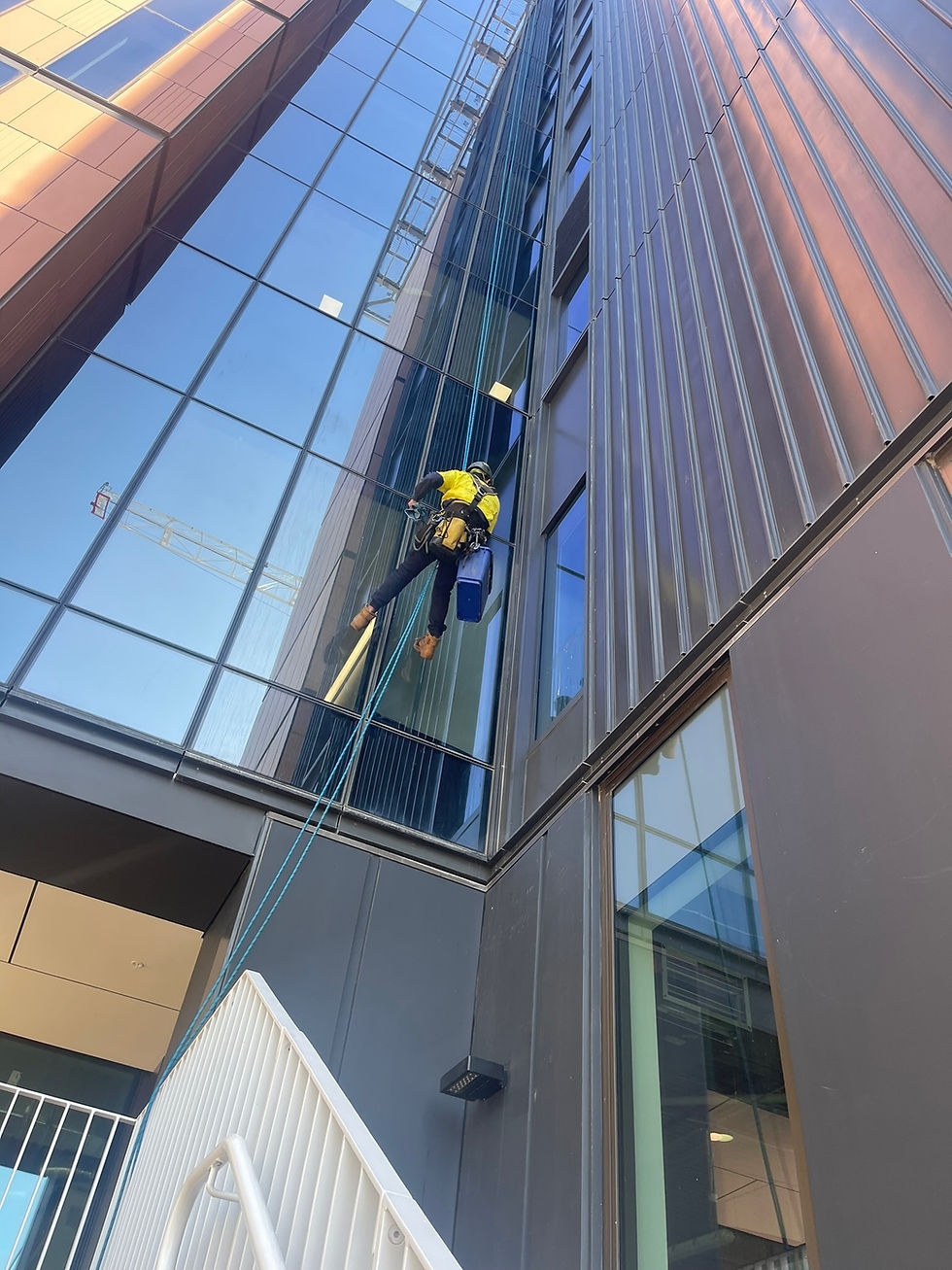
Rope access window cleaning, also called abseil window cleaning, is used when technicians need to reach high, recessed or awkward glass from above.
A trained technician works on a primary rope and a separate safety system. The ropes connect to suitable roof anchors or another designed access system.
This method is often useful for:
High-rise building window cleaning
Apartment towers
Office façades
Balcony glazing
Light wells
Atriums
Sloped glass
Recessed panels
Buildings with narrow ground access
Façades with projections or overhangs
For many sites, rope access requires less space at ground level than scaffolding or large machinery. It may also reduce disruption around entrances, loading areas, roads and pedestrian zones.
However, rope access is not automatically the best method for every property. A low-rise building with clear ground access may be better suited to a water-fed pole. A large, flat elevation may suit a building maintenance unit when one is available and operational.
The correct choice should follow a site assessment, not a sales assumption.
For tall and complex properties, see high-rise window cleaning in Sydney.
How Does Cleaning Help Professionals Find Glass and Façade Defects?
A window cleaner is not a substitute for a structural engineer, façade consultant or licensed glazier. However, close access gives technicians a view that building managers do not have from street level.
During building glass cleaning, technicians may notice:
Chipped or cracked glass
Scratched panels
Failed or loose sealant
Perished gaskets
Loose cover caps
Corrosion around frames
Water staining near joints
Damaged window hardware
Surface deposits that may need specialist treatment
Loose items on ledges
Signs of water entry
Dirt can hide some of these signs. Once a pane and its edges are clean, the condition is easier to assess.
This is a valuable side benefit of façade window cleaning, but it must be described honestly. Window cleaning is a maintenance service, not a full façade condition assessment unless inspection and reporting are part of the agreed scope.
Where broken or inaccessible panels require attention, the abseiling glazing service may be a relevant next step.
How Often Should Sydney Building Windows Be Cleaned?
There is no single cleaning frequency that fits every building.
A practical plan may look like this:
Building condition | Possible starting schedule |
Busy CBD office with heavy traffic exposure | Every three to four months |
Harbour-front or coastal property | Every three to six months |
Retail or hospitality frontage | Monthly or as appearance requires |
Typical strata apartment building | Every six months |
Lower-exposure suburban office | Every six to twelve months |
Active construction or post-construction site | Based on project stages and handover needs |
Problem areas below vents, ledges or runoff paths | Targeted cleaning between full services |
These are planning examples, not fixed rules. A site inspection should determine the final frequency.
The best schedule is often based on the point at which the glass begins to look poor—not the point at which the contamination has already become difficult to remove.
Is More Frequent Cleaning Always Better?
Not necessarily.
Cleaning too rarely can allow residue to harden. Cleaning without the right method can also damage glass, coatings or frames.
The goal is appropriate cleaning at an appropriate interval.
A sensible maintenance program should consider:
Building location
Façade orientation
Glass type
Coatings or films
Nearby roads
Salt exposure
Construction activity
Bird activity
Rainwater runoff
Tenant expectations
Access setup costs
Previous cleaning results
Some buildings also benefit from partial cleaning between full services. Entrances, lower floors, lobby glazing and highly visible elevations may need more frequent attention than upper or hidden areas.
Professional Cleaning Versus Basic Window Washing
The difference is not simply the type of squeegee used.
A professional commercial building window cleaner should bring structured access planning, surface knowledge, safety controls and consistent quality checks.
Basic cleaning may be suitable when:
The glass is at ground level
Access is simple
Contamination is light
There is no risk to people below
The surface has no special coating or damage
Professional high-access cleaning is more suitable when:
The building has multiple storeys
Glass cannot be reached safely from the ground
The façade has recesses or overhangs
A work area must be controlled below
Anchor points or roof access must be checked
The glass has stubborn or unknown contamination
Strata or commercial documentation is required
The building needs photo reports and scheduled maintenance
This is especially important for tower window cleaning, where access, weather and work sequencing can affect both safety and results.
What Are the Main Benefits and Limitations?
What building owners value
A cleaner and more professional façade
Better views and daylight
Less visible salt, dust and water spotting
Safer access to difficult windows
Early notice of visible defects
Reduced need for disruptive access equipment in suitable cases
Planned maintenance rather than reactive cleaning
Before-and-after documentation when included
Limitations to understand
Cleaning cannot remove every old stain
Permanently etched or scratched glass may need restoration or replacement
Some façade coatings require special care
Work may need to pause in unsafe weather
Rope access depends on suitable certified attachment systems
Heavy construction residue may need a separate specialist process
A clean does not replace a formal façade inspection
Being clear about these limits builds more trust than promising that every pane will look new.
A Practical Sydney Building Example
Consider a strata building near the harbour with glass balconies and upper-storey windows.
At first, residents may complain about a cloudy view and white spotting. From the ground, the issue may look like ordinary dirt. Close inspection could show a mix of salt film, mineral marks beneath façade joints and bird waste on ledges.
A good maintenance response would be to:
Inspect each elevation and identify the contamination.
Confirm safe roof and rope-access arrangements.
Test the cleaning method on a small area.
Clean the glass without dragging dry grit across it.
Record any permanent marks that do not respond.
Photograph cracked seals or damaged panels.
Recommend a realistic recurring schedule.
The key lesson is that professional cleaning does more than improve the view on one day. It creates a repeatable maintenance process and a clearer record of the façade’s condition.
This example illustrates a common maintenance situation; it is not presented as a named customer testimonial or a claimed Select Abseiling Solutions project.
How Can Select Abseiling Solutions Help?
Select Abseiling Solutions provides professional window cleaning services for commercial, strata, apartment, high-rise and difficult-access buildings across Sydney.
Depending on the property, assistance may include:
High-rise window cleaning
Rope access and abseil window cleaning
Commercial building window cleaning
Strata window cleaning
Exterior building window cleaning
Glass façade cleaning
Post-construction cleaning
Access planning
Photo reporting
Related glazing and building-maintenance support
Its service page states that its Sydney rope-access work is performed by certified technicians and is supported by public-liability coverage, site assessments and safety documentation. Building owners should still request and review current certificates, the proposed work method and site-specific documentation before approving any contractor.
For broader access and façade services, visit Select Abseiling Solutions.
What Should You Ask Before Hiring a Building Window Cleaner?
Use these questions when comparing a proposal:
What access method will be used, and why?
Have you inspected the site before setting the final price?
Are the technicians trained for the proposed access method?
Can you provide current insurance documents?
Will a site-specific safe work method be prepared?
How will areas below the work be protected?
What products and tools will be used on the glass?
How will mineral deposits or construction residue be treated?
Are frames, sills and ledges included?
Will visible defects be photographed and reported?
What happens if wind or rain makes the work unsafe?
Is the quote fixed, and what could create extra costs?
What cleaning frequency do you recommend for this site?
Can the work be scheduled to reduce disruption to occupants?
A strong contractor should be able to explain the method in plain language.
Frequently Asked Questions
Does window cleaning make glass last longer?
Regular cleaning can support glass longevity by removing salt, grit, bird waste, minerals and other contaminants before they become harder to treat. It cannot reverse permanent scratches, deep etching, failed seals or damage inside an insulated glass unit.
Can dirty windows affect natural light?
Yes. Dust, traffic film, salt and streaking reduce visual clarity and can make interiors feel duller. The effect varies with the amount of contamination, glazing type and direction of sunlight.
Can rain clean high-rise windows?
Rain may rinse loose dust, but it does not provide a controlled clean. It can also leave streaks or deposits, especially when water carries dirt from ledges, concrete or façade joints.
Is rope access safer than ladders for tall buildings?
For appropriate high-access work, a designed rope-access system operated by trained technicians can provide controlled access without relying on tall ladders. The correct method still depends on a site risk assessment and suitable anchorage.
How much does commercial window cleaning cost in Sydney?
Pricing depends on the building’s height, glass area, access method, condition, frequency and ground-level controls. A site-specific quote is more reliable than a flat per-window estimate. See the current commercial window-cleaning cost guide for Sydney.
Who normally pays for strata window cleaning?
Responsibility depends on whether the windows form part of common property, the strata plan, applicable by-laws and the agreed maintenance arrangements. This guide on who pays for high-rise window cleaning in NSW strata buildings discusses the issue in more detail.
What if the glass is already cloudy after cleaning?
Cloudiness may be caused by mineral deposits, chemical staining, surface etching, scratches, failed coatings or condensation inside a sealed glass unit. Further assessment may be needed before promising restoration.
Related Sydney Window and Façade Guides
Final Verdict
A professional building window cleaner does more than remove visible dirt. The service helps maintain the way a property looks, reduces the time contaminants remain on exterior glass and gives trained technicians an opportunity to notice visible defects at close range.
For Sydney buildings, the strongest results come from matching the cleaning method and frequency to the property’s actual exposure. Harbour salt, CBD pollution, construction dust and difficult façade access all require different planning.
The practical approach is simple:
Inspect the building.
Select the safest suitable access method.
Use a cleaning process suited to the glass and contamination.
Record defects.
Set a schedule before the façade becomes heavily stained.
Select Abseiling Solutions can assist Sydney strata managers, facility managers, property owners and commercial clients with professional building window cleaning, high-access work, difficult-access glass and planned exterior maintenance.
Bottom line: Regular professional cleaning protects presentation immediately and supports better long-term care of the glass, frames and wider façade.


Comments