Rope Access vs Scaffolding: Which Is Better for Sydney Buildings?

Quick answer
For most Sydney high-rise jobs, rope access is cheaper, faster and less disruptive than scaffolding, often costing 30–60% less and finishing in days rather than weeks, while scaffolding still wins for ground-level work, heavy materials, or jobs where many tradespeople need to stand on a platform at once.
If you manage, own, or maintain a building in Sydney, you've probably faced this exact question: do you call a rope access team, or book in a scaffolding company? Both can get a job done safely, but they're built for very different situations, and picking the wrong one can mean weeks of delay, a much bigger invoice, and a building wrapped in metal poles for longer than anyone wants.
We've been providing rope access services Sydney-wide for years, working on everything from harbourside apartment towers in Coogee to glass-fronted commercial buildings in the CBD. This guide compares rope access vs scaffolding across cost, speed, safety, and practicality, with real numbers from 2026 jobs, so you can make the right call for your building before you pick up the phone.
What is rope access, and how does it work?
Rope access (sometimes called abseiling or industrial abseiling) uses two independently anchored ropes, a harness, and specialised descent equipment to let technicians work safely on the outside of a building. It's the same fall-protection philosophy used in mountaineering, adapted for industrial work, and governed in Australia by strict IRATA-aligned safety standards.
A typical high rise rope access Sydney crew of two to four technicians can be set up on a building's roof anchors within an hour or two, then work their way down the façade completing tasks like:
Rope access window cleaning Sydney for high-rise apartments and offices
Rope access caulking Sydney and joint sealing around windows and panels
Rope access leak repairs Sydney for water ingress and façade cracks
Rope access façade inspection Sydney and condition reports for strata buildings
Rope access painting Sydney for render touch-ups and full façade repaints
What is scaffolding, and when do builders use it?
Scaffolding is a temporary structure of metal poles, frames, and platforms erected against (or freestanding from) a building. It gives multiple tradespeople a stable, code-compliant surface to stand on, store materials, and work for extended periods, which is exactly why it's still the go-to for major construction and renovation jobs.
Scaffolding shines when a job needs:
Several trades on site at once (painters, renderers, electricians, glaziers)
Heavy materials, large tools, or bulky equipment stored at height
Long-duration projects (multi-week renovations or rebuilds)
Work close to street level where rope access anchor points aren't practical
The trade-off is footprint and time. A scaffold has to be designed, engineered (for anything over 4 metres, by a licensed scaffolder under AS/NZS 1576), erected, inspected, used, then dismantled, all of which adds cost and weeks to a project timeline.
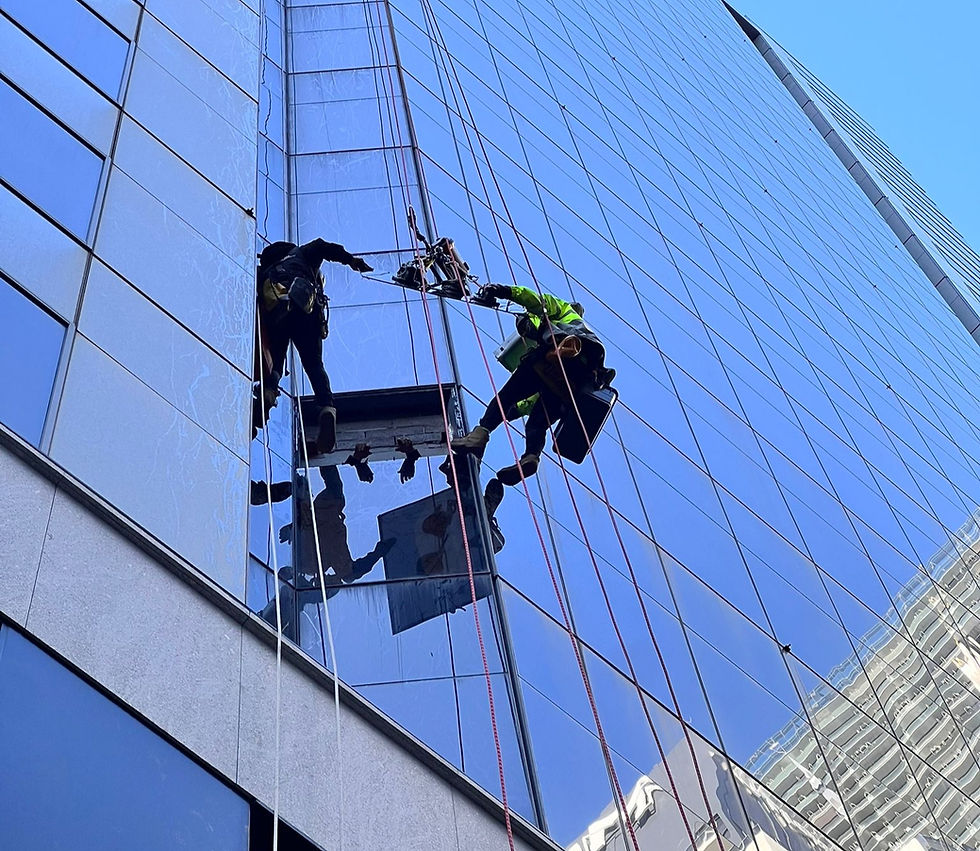
Is rope access cheaper than scaffolding in Sydney? (2026 cost comparison)
This is the question we get asked most, and the honest answer is: it depends on the scope, but for most façade and window-related work, yes, rope access is usually significantly cheaper. Here's how the numbers typically stack up for a mid-rise Sydney building (around 10–15 storeys) needing façade inspection, window cleaning, and minor sealant repairs.
Factor | Rope access | Scaffolding |
Typical setup time | Half a day to one day | Several days to two weeks (design + erection) |
Indicative weekly cost (10–15 storey building) | Usually billed per job, not per week | Roughly $1,800–$4,600+ for erection and weekly hire, depending on scale |
Footpath / street closure | Rarely required | Often needed, plus council permit fees |
Ongoing weekly hire fees | None, the job is priced once | Yes, costs add up the longer the job runs |
Best for | Spot repairs, cleaning, inspections, sealant work | Full façade renovations, multi-trade projects |
The reason rope access often comes out cheaper isn't magic, it's that you're not paying to build, certify, hire by the week, and then dismantle a temporary structure. A two-person rope access crew can complete a job that would otherwise require a scaffold sitting on the building for one to two weeks, often in a single day or two.
Quick tip: For strata committees, if your only outstanding item is window cleaning, façade inspection, or a handful of leaking joints, ask your contractor whether rope access vs scaffolding changes the quote before committing to a full scaffold hire. The savings on smaller jobs are usually the biggest.
How much faster is rope access than scaffolding?
Speed is where the gap is widest. Scaffolding for a high-rise needs an engineer's design, a booking with a licensed scaffolding crew, council approval if it touches public footpaths, and then the actual erection, which itself can take several days for a tall building. Add the dismantling at the end and you're often looking at two to three weeks of total project time before and after the actual work happens.
With rope access, the "setup" is anchoring to existing roof anchor points (already installed and certified on most modern Sydney buildings) or temporary anchors rigged in under an hour. From there, the crew is working the same day. For a typical façade inspection or window cleaning job, that means the difference between a job finishing this week versus a job that won't even start for another fortnight.
From the field — 2026: In March 2026, a strata manager in Parramatta contacted us after a scaffolding quote for window cleaning and minor caulking on a 14-storey residential tower came back at over three weeks lead time, mostly waiting on scaffold design approval. Our rope access crew was on site within five days and completed the rope access window cleaning Sydney and caulking work across the full façade in two and a half days.
Is rope access as safe as scaffolding?
Both methods are safe when carried out by certified, insured professionals following the correct standards, but they manage risk differently. Scaffolding creates a fixed platform that removes the need for individual fall arrest in many situations, provided it's erected and inspected correctly. Rope access relies on redundant systems, meaning every technician is connected to two independent anchor points and ropes at all times, so a failure in one system doesn't result in a fall.
The data from the Australian industry consistently shows rope access has a strong safety record when operators are properly trained and equipped, largely because the redundancy is built into every single movement, not just the platform. The bigger risk with either method usually comes down to the contractor, not the method itself: unlicensed scaffolders, expired anchor certifications, or technicians without current rope access qualifications are the real red flags.
When choosing a rope access contractors Sydney team, always check for:
Current rope access certification for every technician on the rope
Public liability insurance specific to height work
Documented Job Safety Analysis (JSA) for the specific building
Certified anchor points, inspected within the last 12 months
Which causes less disruption to residents and businesses?
This is often the deciding factor for occupied buildings. Scaffolding sits on the building (sometimes for weeks), can block natural light, restrict balcony access, cover signage on commercial buildings, and may require footpath closures that affect foot traffic for ground-floor retail tenants. For a hotel, office tower, or apartment building where residents and customers are present every day, that's a real cost beyond the invoice.
Rope access, by comparison, is largely invisible once the crew packs up at the end of the day. There's no structure left standing overnight, no blocked balconies, and minimal impact on entrances or footpaths. For difficult access services Sydney buildings, like those with awkward setbacks, heritage facades, or limited ground space, rope access is often the only practical option anyway, since there may not be room to erect a scaffold at all.
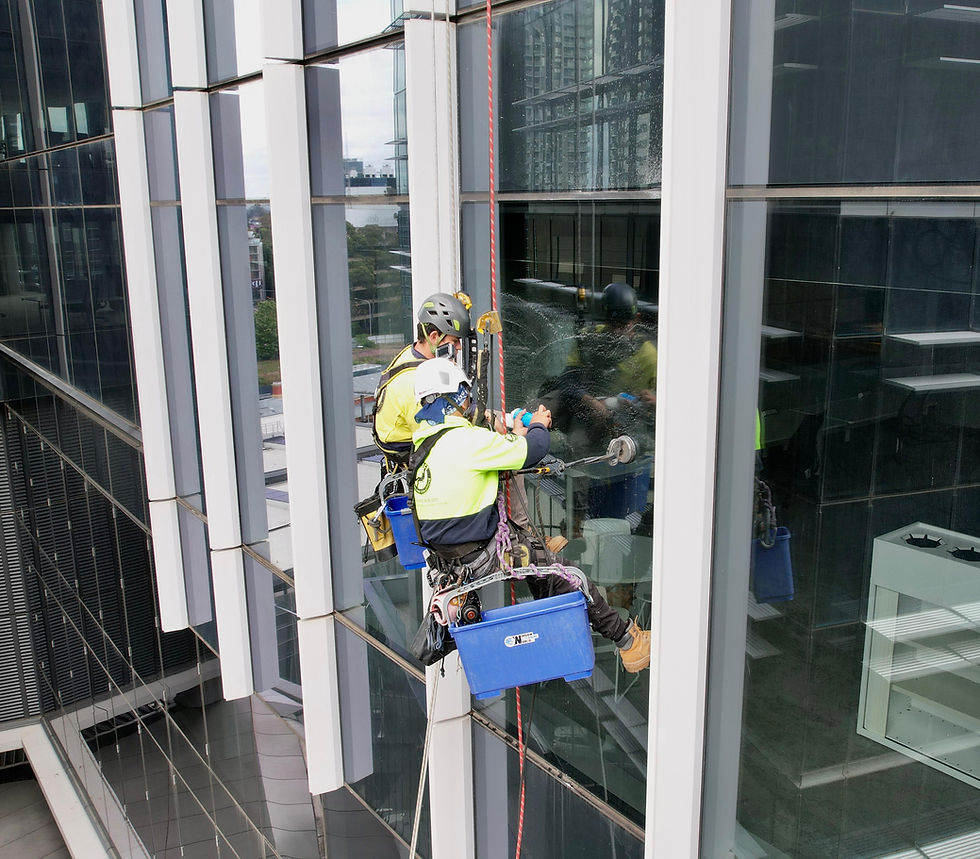
When should you choose rope access or scaffolding?
Rather than treating this as a strict either/or, the smartest approach is matching the method to the job. Here's how we typically advise Sydney building managers and owners.
Choose rope access when:
The job is window cleaning, façade inspection, caulking, leak repair, or spot painting
You need it done quickly, especially for urgent leak or safety issues
The building has limited ground space, heritage constraints, or busy street frontage
You want minimal disruption to residents, tenants, or pedestrians
The building already has certified anchor points installed
Choose scaffolding when:
Multiple trades need to work simultaneously over several weeks
The job involves heavy materials, full re-cladding, or structural repairs
Work is happening close to ground level where scaffolding is quick to put up
Local regulations or insurance for the specific job require a platform
Many of our Sydney clients actually use both at different stages of a project: scaffolding for the heavy structural and cladding work, then rope access afterwards for the detailed finishing touches like sealant lines, glass cleaning, and façade touch-ups, since it's far cheaper than keeping the scaffold up just for the final stages.
Real Sydney case study: a coastal apartment building, 2026
One of our 2026 jobs involved a beachside strata building in Bondi facing two issues at once: salt-affected windows that hadn't been professionally cleaned in over a year, and a handful of sealant joints that had failed, allowing water into two apartments below.
The strata committee's first quote, from a scaffolding company, covered the whole building, with an estimated three-week timeline and a hire cost that reflected weeks of standing scaffold. After a site visit, our team proposed a rope access approach instead: rope access leak repairs Sydney for the failed joints, combined with a full façade rope access window cleaning Sydney pass while the crew was already on the ropes.
From the field — 2026: The job ran over three days with a four-person crew. The committee avoided the council footpath permit altogether (the building fronts a busy coastal road), and residents reported no disruption to balcony access throughout. The combined cost came in well under the original scaffolding-only quote for cleaning alone, before the leak repairs were even added.
How Select Abseiling Solutions can help with your decision
Every building is different, and the right answer to rope access or scaffolding depends on your building's height, layout, existing anchor points, and the scope of work. Our team can carry out a free, no-obligation site assessment of your building in Sydney to recommend the most cost-effective and least disruptive approach.
As an established rope access alternative to scaffolding Sydney provider, we offer:
Rope access façade maintenance Sydney and condition inspections
High-rise window cleaning for residential, strata, and commercial towers
24/7 emergency rope access for urgent leaks and safety issues
If you're not sure which method suits your building, our team can talk through both options honestly, including telling you when scaffolding genuinely is the better call. You can get in touch via our contact page or book an assessment online.
Frequently asked questions about rope access vs scaffolding in Sydney
Is rope access cheaper than scaffolding for a single building?
For most façade-related work, such as cleaning, inspections, caulking, and minor repairs, rope access is usually cheaper because there's no weekly hire fee, no engineering design cost, and no erection or dismantling time. Scaffolding becomes more cost-competitive for long, multi-trade jobs where many workers need a stable platform for weeks at a time.
Do Sydney strata buildings need council approval for rope access?
Rope access typically doesn't require footpath closures or council permits, which are sometimes needed for scaffolding on public land. However, strata buildings should still check their building's bylaws and ensure the contractor has appropriate insurance and certified anchor points before work begins.
Can rope access be used on heritage buildings in Sydney?
Yes, rope access is often preferred for heritage facades because it avoids drilling large scaffold footings into footpaths or heritage-listed surfaces and leaves minimal visual or physical impact on the building's exterior.
How long does a rope access job usually take compared to scaffolding?
A rope access crew can often start work within a day or two of booking and complete a typical façade job in one to three days. The same scope using scaffolding can take two to three weeks once design, approval, erection, and dismantling time are factored in.
What if my building doesn't have rope access anchor points installed?
Many Sydney high-rises built or refurbished in recent years already have certified roof anchors. If yours doesn't, a qualified rope access provider can assess whether temporary anchors are suitable for the job or recommend permanent anchor installation for future maintenance work.
Final verdict: rope access vs scaffolding for Sydney buildings
For the vast majority of Sydney buildings needing window cleaning, façade inspections, caulking, leak repairs, or painting touch-ups, rope access is the better choice: faster, less disruptive, and typically more cost-effective once you factor in hire fees, permits, and lost time. Scaffolding still has its place, particularly for major construction, re-cladding, or jobs that genuinely need multiple trades working at height for weeks at a time.
The best approach is to get a proper assessment of your specific building and job scope before committing either way. If you're weighing up rope access vs scaffolding for an upcoming project in Sydney, our team is happy to walk through the options with you and give you an honest recommendation, even if that means telling you scaffolding is the right call for your job.
Select Abseiling Solutions is a Sydney rope access and building maintenance specialist. Our
IRATA-aligned technicians have completed hundreds of high-rise façade, window cleaning, and maintenance jobs across Sydney. Learn more about our team or browse our full range of services.

Comments